In Paris, about six blocks southeast of the Arch of Triumph, is a small park called Place des Etats-Unis, or United States Park, though sometimes called Square Thomas Jefferson. The streets on all four sides of the park are lined with beautiful, historical mansions which have served as embassies, residences for princes, and one for the patron of Jean Cocteau. Another was occupied by the Gestapo during WWII. The American novelist, Edith Wharton lived for a time in one house, while in another lived a Viscountess who threw parties for the likes of Pablo Picasso, Balthus, Henri Matisse, and Salivador Dali. It's a nice neighborhood.
There are three monuments in the park. One is of Marquis de La Fayette shaking hands with George Washington, designed by sculptor Frederic-Auguste Bartholdi, designer of the Statue of Liberty, standing in New York Harbor. There is an exact replica of the La Fayette - Washington monument in Morningside Park in New York, up in Harlem. The figures are double size.
The second monument is one of a person you may either bless or cursewhen in the dentist's office - an American dentist, Horace Wells, an early inventor of an anesthesia,nitrous oxide or laughing gas. A sad story there. He learned of the effects of the gas in a circus, performed a few successful extractions using it, but then became addicted to chloroform and so deranged from it he committed a crime by throwing acid onto two prostitutes. He committed suicide in remorse. For some reason my dentist finds this story amusing; but then, he finds McTeague, by Frank Norris, amusing. Both the American Dental and Medical Associations honored Wells posthumously in1864, and have credited him as the discoverer of modern anesthesia.
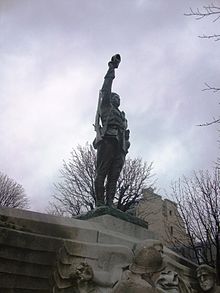
The third monument is of Alan Seeger, a poet who was born in New York and lived part of his his adolescence in Mexico. He returned to the US to attend Harvard college, becoming an editor of the Harvard Monthly where he regularly submitted his poetry. After graduation, Seeger lived a bohemian lifestyle in Greenwich Village for two years, moving to Paris in 1912. After the outbreak of WWI he joined the French Foreign Legion, serving in the trenches on the Western Front. During quiet hours of guard duty he composed verse.
In 1915 he wrote in a letter, "If it must be, let it come in the heat of action. Why flinch? It is
by far the noblest form in which death can come. It is in a sense
almost a privilege. . ."
Rendezvous - byAlan Seeger
I have a rendezvous with Death
At some disputed barricade,
When Spring comes back with rustling shade
And apple-blossoms fill the air--
I have a rendezvous with Death
When Spring brings back blue days and fair.
It may be he shall take my hand
And lead me into his dark land
And close my eyes and quench my breath--
It may be I shall pass him still.
I have a rendezvous with Death
On some scarred slope of battered hill,
When Spring comes round again this year
And the first meadow-flowers appear.
God knows 'twere better to be deep
Pillowed in silk and scented down,
Where love throbs out in blissful sleep,
Pulse nigh to pulse, and breath to breath,
Where hushed awakenings are dear . . .
But I've a rendezvous with Death
At midnight in some flaming town,
When Spring trips north again this year,
And I to my pledged word am true,
I shall not fail that rendezvous.
Alan Seeger was killed at Belloy-en-Santerre
on July 4, 1916, after being hit several times by machine gun fire, said while cheering on his fellow soldiers in a
successful charge.
Ode in Memory of the American Volunteers Fallen for France -byAlan Seeger
(To have been read before the statue of Lafayette and Washington in Paris, on Decoration Day, May 30, 1916). First, fifth stanzas.I
Ay, it is fitting on this holiday, Commemorative of our soldier dead, When -- with sweet flowers of our New England May Hiding the lichened stones by fifty years made gray -- Their graves in every town are garlanded, That pious tribute should be given too To our intrepid few Obscurely fallen here beyond the seas. Those to preserve their country's greatness died; But by the death of these Something that we can look upon with pride Has been achieved, nor wholly unreplied Can sneerers triumph in the charge they make That from a war where Freedom was at stake America withheld and, daunted, stood aside.
V
There, holding still, in frozen steadfastness, Their bayonets toward the beckoning frontiers, They lie -- our comrades -- lie among their peers, Clad in the glory of fallen warriors, Grim clusters under thorny trellises, Dry, furthest foam upon disastrous shores, Leaves that made last year beautiful, still strewn Even as they fell, unchanged, beneath the changing moon; And earth in her divine indifference Rolls on, and many paltry things and mean Prate to be heard and caper to be seen. But they are silent, calm; their eloquence Is that incomparable attitude; No human presences their witness are, But summer clouds and sunset crimson-hued, And showers and night winds and the northern star. Nay, even our salutations seem profane, Opposed to their Elysian quietude; Our salutations calling from afar, From our ignobler plane And undistinction of our lesser parts: Hail, brothers, and farewell; you are twice blest, brave hearts. Double your glory is who perished thus, For you have died for France and vindicated us.
Seven years to the day after Seeger was killed, on 4 July 1923, the President of the French Council, Raymond Poincaré, dedicated the monument in the Place des États-Unis to the 24 Americans who had volunteered to fight in World War I in the service of France.
It is inscribed:
"They did not pursue worldly rewards; they wanted nothing more than to
live without regret, brothers pledged to the honor implicit in living
one's own life and dying one's own death. Hail, brothers! Goodbye to
you, the exalted dead! To you, we owe two debts of gratitude forever:
the glory of having died for France, and the homage due to you in our
memories."
"I Have a Rendezvous with Death" was one of President Kennedy's favorite poems. His wife Jacqueline often recited it for him.
Seeger's collected work, Poems was published posthumously and was not very successful, because, it was said, the language and ideals were too lofty. It was reviewed by one of his Harvard classmates, T.S. Eliot:
"Seeger was serious about his work and spent pains over it. The work
is well done, and so much out of date as to be almost a positive
quality. It is high-flown, heavily decorated and solemn, but its
solemnity is thorough going, not a mere literary formality. Alan
Seeger, as one who knew him can attest, lived his whole life on this
plane, with impeccable poetic dignity; everything about him was in
keeping."
Alan Seeger's brother Charles, a noted musicologist, was the father of the American folk singer, Pete Seeger.
We have all had a professor or two that have had an exceptional impact on us. This story is about one of them.
A few years ago, a
friend was at her wits end with her son who had no interest in classes
that were not about science, where, thankfully, he was doing well. She thought I
might be able to help and asked if I would write a short note to him:
Dear Toni,
Your mother tells me you have been doing some animation.
I assume computer animation. If so, I can only love the technology behind it and respect your understanding of it. We
used to think only of cartoons and Disney movies in this context
but I know animation has moved way beyond that -
medical training, abstract modelling, pilot simulation, etc, (not to mention Halo or EA,
Grand Theft Auto).
She asked me to offer you my thoughts
regarding the study of the humanities in general, of literature and poetry. I feel I am slightly able to do this as I have in my
time read many of the
books which appear as "classics" on several
scholarly lists, as well as an assortment of cheap novels, pulp fictions, comic books, high adventure stories. I
have read my share of abbreviated Cliff's Notes to get the gist
of a classic when time to read the whole book before the exam was not
available. I have been to many museums, gone to many concerts, some rock and some classical. I have also read a lot of poetry and even tried writing some.
But I have read, seen things, heard
music - that turned me sideways, that made me feel haunted and humbled. And, truth be told, the more you know about the thing, the more you will be able to appreciate it.
My first day in my first class in college, in the
elective subject of Humanities 101, I walked into the lecture hall of a certain Dr. Pletz, a
slim, animated, gentle man who always wore a black suit with a red or black turtleneck sweater,
which made his shock of white, unruly hair stand out. The first thing he said was to never say "I know what I like" - rather, to say "I like what I know". Then began the lessons to expand that which we liked and which we
knew. He was strict - he called out randomly to the hall and asked you to leave if you were unprepared -
because he said the world tossed you out if you were unprepared. But he also became one of the artists he spoke about.
Over the year, the class was a survey of the many
disciplines of the humanities: language and linguistics, history and
literature, but also the arts: theater, music, dance,
painting, architecture. In short, pretty much the gamut of human intellectual endeavor
- save the sciences.
For his fresh-faced
students, Dr. Pletz held open the door and pushed, pulled as we piled
through to appreciation and understanding, to a view of the incredible
world where
artists, including computer animators, interpret the world with original
words, clay, music notes, and motion. Where
they make inquiries into values, ethics, ideals. Where they define
truth and
beauty - and their opposites.
Among some of the classics we read was Aristotle's Poetics concerning the seven
parts
of a play. We read John Ciardi'stranslation of Dante's Divine Comedy, as well as his "How Does a Poem Mean?", about how to read and write poetry, where he tells of a
poet who says he writes because he "likes to hang around words". The survey covered the
masters of renaissance art, French and English painting up to the twentieth century, and finally, the music of some of the great classical and modern composers.
Needless to say, Dr Pletz inspired me. I went on
to publish six novels, two plays, and several volumes of poetry. Just kidding.
But I did expand what I know and still never say I know what I like. Perhaps I
would have an appreciation of the humanities without this
particular professor, but it would not have been the same. I think of him whenever
I read a poem or see a play. Hopefully, you will meet someone like him.
Probably the best known American poet is Robert
Frost. He won the Pulitzer Prize four times. Though some say his poems are
very dark, I think they are not too murky and
have an easiness about them. He recited at Kennedy's inauguration. "The Road
Not Taken" and "Stopping by Woods on a Snowy Evening" are two of his better
known poems. You can find these in the American Poems link below. Read them, if you like, and let me know what you
think of them. I know your mother likes poetry and she would enjoy your discussing them with her.
Carl Sandburg is also well known, born near
Chicago. Here is an apropos poem of his.
BATH
A man saw the whole world as a grinning skull and
cross-bones. The rose flesh of life shriveled from all
faces. Nothing counts. Everything is a fake. Dust to
dust and ashes to ashes and then an old darkness and a
useless silence. So he saw it all. Then he went to a
Mischa Elman concert. Two hours waves of sound beat
on his eardrums. Music washed something or other
inside him. Music broke down and rebuilt something or
other in his head and heart. He joined in five encores
for the young Russian Jew with the fiddle. When he
got outside his heels hit the sidewalk a new way. He
was the same man in the same world as before. Only
there was a singing fire and a climb of roses everlastingly
over the world he looked on.
My old friend Drew, a one-time pro tennis
player and later a club pro at posh resorts in the Caribbean, showed up every once in a while
to catch up on what was new with me, and to play a little tennis and golf a few rounds. Through the years, we played tennis on
a lot of courts, both clay and composite, and golfed mostly average but occasionally championship courses around the country. With a little planning, we could cross paths on our
travels. We often played gratis because many courses gave a courtesy pass to
Drew, who never failed to inform everyone in the clubhouse that he was a
Tennis Pro and could reciprocate for the greens fees with free
tickets for local sporting events.
Of
course, being a Pro, Drew could blow me off the
court even when he backed off from the full power of his huge serve,
one of the fastest recorded
in the history of tennis, somewhere over 150 miles per hour. It was
rare that I ever got to add-in, meaning my advantage, needing only one
point to win a game. When the score reached "deuce" (tied, in tennis parlance) and Drew needed a couple of big serves to put me
away, called "aces" as they skipped by, I didn't see much of them and was just glad they didn't hit me. Then I felt more like a light-weight sparring partner in the ring with a heavy-weight champion trying to duck late round KO punches. Sometimes I could win a game or two in a set, but truth be told, Drew easily, spectacularly outplayed me, and scores of
every set and match were dismal.
On the other hand, I had read Mickey Wright and some of the books of a few other golf greats to learn how to hit the ball straight and had taken lessons on the intricacies of the short game, so I could nearly always beat Drew on the golf course. With his big drives, Drew rarely hit the ball into the fairway and usually found every water
hazard and sand trap on the course. He got to
know how I felt when on the tennis court nearly every volley ended with my eventual return long, wide, or into the net.
Dinner and drinks always followed our outings wherever we were, at a
local steakhouse or sports bar. Score cards, brilliant shots, lucky
shots would be hashed over, always with a lot of kidding and laughs. We
were always out to have good fun times, to not really compete
seriously, except perhaps in good-natured gamesmanship. We played well because there was no tension
or pressure to beat the other guy. As most golfers know,
your game improves when you have a relaxed, easy swing, and are able to forget the
previous bad hole or other problems.
Things were about to change.
Our
first competition was at hand, though it would still be with a
lot of kidding and laughs. It took place in our favorite venue at what was then the old Lake Geneva Playboy Club Resort
(I guess we were sort of small time amateur playboys) that had two of
the most enjoyable golf courses we played. Lake
Geneva had been the flagship Playboy Club Golf Resort in the country and
had attracted all the major
entertainers when Hugh Hefner wore something other than bathrobes and slippers. The
resort hotel had been closed for several years and was in disrepair, quite run-down. The place
was kept open summers because its two golf courses were popular and always had
their tee times fully booked.
After the golf round we of course went into the clubhouse for the usual customary drinks, as golfers always do, traditionally called
the 19th hole. At the clubhouse though, we were told that the
bar was in the otherwise shuttered hotel, the only room still
open and used, that we should just keep walking down the long
darkened corridor and we would be sure to find it all the way in the
back, turn right and you'll see it, the room with the large windows
giving a panoramic view overlooking both courses. So in we went.
Walking
into that empty,
barely lit bar it was game on. Our first competition began, winner take all, no second place - for we were stunned by the apparition standing
behind the bar, knowingly smiling at us as we approached. Lisa, deeply
tanned, elegant, was the dark-haired bartender, who would have shamed
any of those Playboy Bunnies for sheer beauty (to our eyes) and as we were to see, for
her wit, charm, guile, intelligence, what have you. She and the barmaid,
Cheryl, were law students at UW and were working summers at the club probably
as much to make blustering fools of golfers who thought they could make
the slightest impression on them, as well as for the tips, which increased exponentially when Drew and I were around.
I'm not the ugliest guy around, and Drew isn't
exactly the best looking guy in the world,
but he is big, over six feet tall, blond, and a Tennis Pro, which he likes
to point out. And he always has this grin on his face to match
his sunny personality. All right, I'm none of those things,
haven't got a big sunny grin, so he has me at a disadvantage,
or as he likes to say, add-out. Being familiar with the worldly Emily Hahn's Seductio ad Absurdum, at least I knew even under the circumstances that tossing
pick-up lines to waitresses, barmaids, and bartenders is juvenile
and banal, but golfers have been known to get that way, - so Drew's
lead-off was his ever present boyish grin which slightly disarmed Lisa, who was, sad to say, also impressed that he was a Tennis
Pro, - naturally, the first thing that got brought up.
My
situation was rapidly deteriorating and I sought something to
get to add-in, or just to even the score at deuce if I wanted to stay in the game. Drew had racked up
several points with some well practiced lines to my nil, when to my
relief Lisa mentioned her pride in being part American Indian, one-quarter,
because her mother was half Indian, of the Wisconsin Oneida tribe. A break,
because I happen to be part Indian from my mother's side, descending from a northern plains tribe. That got her attention, so taking full advantage (add-in), I
asked Lisa for her Indian name.
Such luck, she didn't have one. Very
seriously, because it is, I said we might perform the naming ritual, if she liked, according to tribal conventions, to give her one if I could summon it. The name would have to intimate and merit her physical and spiritual traits, be nature
based, and fitting for her. She agreed, so I reached back for things my mother long ago told me about old handed-down tribal tales, the sagas and songs, some which were heroic, of triumph, of successful buffalo hunts, or when the aftermath of a battle with a cavalry company was described as a hill with seeds of scattered white corn. Many more though were poignant, that memorialized long trails and scenes of defeat - and the relentless loss of the vast expanses of buffalo country between the Ponderosa pines in the Black Hills, past the Powder, Tongue, and Yellowstone rivers, to the Wolf, Rosebud, and Bighorn mountains. I thought of the old Indian names of the High Plains Cheyenne: of Two Moons, Black Kettle, and Wolf-on-the-Hill, and of the Teton and Lakota Sioux: Spotted Elk, Red Cloud, and Yellow Bird. And I remembered the ceremony when I had received Standing Water, my Indian name. I recalled that a name would come only after deep reflection, falling into a kind of reverie or mystic dream of then and now, while conjuring images of Indian lore and ways of life, of reading imaginary smoke signals, as best as I can explain it. After several minutes of concentration, it should arrive. The rite involved gripping
hands and passing things back and forth, - for instance, leather and
wooden objects, tobacco pouches and flints, (we substituted things at
hand, wooden spoons from behind the bar, pipe tobacco and lighters).
Trying to add a little pressure, Drew started for the door (gamesmanship) while I
ceremoniously, carefully performed the ritual to beckon the proper
Indian name for her.
Two Moons
Wolf-on-the-Hill
Spotted Elk
Fifteen minutes later it came. She liked it. From then
on Lisa became better known as Summer Wind.
And before every time Drew and I entered the bar we had someone in
advance put a quarter in the jukebox to play Frank's song upon our
entrance - we loved the way, upon hearing it, she spun around to look for us:
Add-in was pleasant - while it lasted. Poor Drew was left
feeling like a lone survivor at the Little Big Horn while I was like a new
brave with a painted pony. Summer Wind - the name was perfect for her. Then the
Tennis Pro offered personal tennis lessons, something she always wanted. Suddenly, I was Salieri, Mozart's second.
Time
for a new ploy, a fresh gambit - a longer club or tighter racquet. But what? I know. Yes, that's it. I'll write some poetry
for her. Never mind I haven't done much of that before, but Summer Wind
is a perfect muse. Let's see, I'll write
one about the three major players, maybe even one to Cheryl, and
anything else that brings inspiration. I might soon have permanent add-in.
First, Drew. This painting was in the bar. The Tennis Pro:
THE TENNIS PRO
Like the Leroy Neiman behind him hanging on the wall
With hazel gaze the tennis pro sets the figure before him
Herself a study in pretty proficiency, bidding his subtle call
The picture paints a player frozen in a blur
Dazzled now, he searches for a clever winning serve
His mind a perfect blank, his tongue covered with fur
His seeded game was regarded with renown - picture perfect
All plot and stratagem, thrust and parry - drop and lob
Then another cross-court victory - poetry with no defect
With flashing fore and backhand, with stunning, numbing play
Against the ilk of Nastase, Connors, and Borg
They all proclaimed him a laureate of the court of clay
Though thoroughly beguiled, his serve shouldn't fail again
But when a withering return flashes from those evoking eyes
He forgoes the match and simply mutters, another tonic and gin.
A time might come when he may know all he needs to know
When vistas open, and she, like the painted frozen player, thaws
And she joins him in the picture, frozen by winter winds that blow.
That surprisingly, seemed to work. Everyone had a good laugh and I was add-in.
Until Drew took the T-tops off the Firebird and offered her a ride - sorry, only room for two. Time for another poem. Framed it - hoped she might weep when I gave it to her: The Bartender.
THE BARTENDER
The hospice had come to a baneful day
Once like a Pantheon on the great Appian Way
Its glories, like Rome, are of yesteryear
When legions gathered for wine and good cheer.
Its rooms and halls are quietly vacant now
Grandeur long gone, time would fain not allow
The grounds are barren where blossoms once reigned
Humbled, they dreamily brood of old splendors again.
Snugged in the back, an anomaly remains
A vestige of glory, of paradise regained
Shaped like a cirque, a circular space
The barrel house is now a time out of place.
Vesta herself, in sartorial rendition
Is keeping the hearth in age-old tradition
Like pouring a libation to honor a deity
She serves to strangers draughts with her fealty.
In grand proportions of varied elements
She plies her craft with refined sentiments.
With an artist’s devise and innocent guile
To concupiscent remarks she renders a smile.
Barmecide of Arabian nights deferring to his wishes
Gave a beggar a sumptuous feast served on empty dishes.
Our bartender now, with ample and graceful geniality
Can succor the soul with her chalice of generosity.
Don Quixote charged the windmills of La Mancha
Richard Wagner rode the Valkyries to Valhalla.
In Camelot, old King Arthur had his tiny spot
But it was here Alexander cut the Gordian Knot.
Against a backdrop of brandy and blend
Against a backdrop of view without end
This maestro with baton, nay - this melodic symphony
Restores to this world things – called peace and harmony.
Against the works of Poe, Shelly, or Michelangelo
Or Longfellow, Leonardo, or even Vincent Van Gogh
These lines when compared pale like miracle to sin
But not the lovely Lisa, better known as Summer Wind.
To
my delight, she did cry when I presented it to her, of course to the
strains of Frank singing her song. She said she hung it her bedroom
(gasp) and read it every night. Now for the coup de grâce, going for game, set, match - the final player, The Poet:
THE POET
To say a poet seeks Truth and Beauty deigns a brief reply
He marks in murky metaphor while he really wonders why
Fair Ganymede and Io spinning in their awesome plane
Shouldn't somehow signal to our world-
As they whirl by again
It's there Beauty's lofty lesson might then best be taught
They are only part of a whole - alone, they come to naught
The moons of Jupiter seem far removed from such a lofty yield
But Truth is men are brethren-
Their welded lot is sealed
While sifting the progression of Nature's perfect contest
And seeing things true and beautiful in her majestic manifest
He writes his letter to the world with metaphor as means to end
With finite eye, his solemn soul peers into infinity-
With Truth and Beauty his only friend
With his words he paints the dawn when the sun touches morning,
He counts the fragrances of spring, Nature’s breath adorning
He points with pleasure to which he seeks at an ever-even pace
And touches, then, the breast of Truth and Beauty-
With tears upon his face
If he justly honors this, his sacred chosen task
And pours his winsome words as from an aurum cask
When he enrolls in the poets' confraternity named so odd
Come Judgement, he can humbly stand erect-
Before the Throne of God
Things were going well - oh, the oddly
named fraternity just above is The Dead Poet's Society - and it was at
this point that Cherylwas starting to feel left out, so I wrote one to her called To Cheryl, The Law Student:
TO CHERYL, THE LAW STUDENT
In Hoc Signo Vinces
Their dour faces echo ironic mockeries of birth
They are the meek who never inherited the earth
The newborn's tears impeach the day's divinity
The disinherited inveigh the earth's serenity
Menageries of militant madmen vie for the others' mud
Then loose the ugly mongrels on our children's blood
Quarrels of ancient wars erupt in insidious incident
Revenging omissions that cannot be considered accident
Chattering blindly, in doomed attempt to resolve a past
Factions, races kill, objecting to the system of caste
That preordains at birth, and inhumes the natural right
To stem the loss of humanity, within a child's sight
The iniquities of this world we love, wretchedly abound
The disjointed and disabled are buried, without a sound
Fleeing fathers sit snug in the trees
Forgotten mothers lie dead in the seas
The other day I opportuned to meet a cool jeweled mind
That just might offer hope to a world in such a bind
She's preparing to answer that stirring clarion call
To law, to serve the needy, the disenfranchised, all
Now if healing can come from planted words that grow
And the adage holds true, you reap that which you sow
If she stands the bar for those with no reward to offer
She won't be looking for that which has already found her
It has been said, for as early though the laurel grows
It withers far quicker than the lovely crimson rose
Her deeds, reposing with renown, will musk her amber wine
And shed the light in which a far better world will shine
An early evening, while we were listening
to the strains of Sinatra crooning his song on the jukebox, Summer Wind
proposed a little mock contest, to see which of us could pick the best place to take her for a romantic trip
on holiday. We were to write our answers on a bar napkin and turn them
over, one at a time. Drew and I of course strained our grey cells
mightily to imagine where in the world would win the day. Lord, Drew
turned up Hawaii, the island paradise of James Michener, From the Sun
Swept Lagoon, and all that rot. I meekly, fearfully turned over my
napkin and incredulously saw a provocative smile and watched her elegant finger
point to... Alaska. A Room With a View:
A ROOM WITH A VIEW
Have you ever had the keys to the kingdom, ever been truly free
Have you seen the exquisite ice castle, the one they call Denali
Then come to the primordial Rim of Fire, restore in resignation
Ride your own Iditarod, lift your spirit to glacial revelation
Shake dreams from your midnight hair, my new and gentle friend
And go on a voyage of discovery, just beyond Vancouver's bend
To a place where, still, the grey timber wolf and caribou run
To a land called Alaska, of northern lights, and midnight sun
The Aleutians, lying like diamonds in the windswept Bering Sea
Point like your slender finger, from Asia to high Mt McKinley
From the empire of Mother Russia, besieged in Crimean volley
He garnered with love, this robust land, known as Seward's Folly
There is gold, they say, in the Yukon River, the beaches of Nome
There are no strangers at her gate, her warm valleys provide home
Now those who missed her Golden Age, of prospecting and violence
Pause at Prince William Sound, for Alaska, in a moment of silence
They say the Aleut and the Eskimo are of hunter, warrior class
Who forage for salmon and seal on treacherous glacier, like glass
In eloquent erudition, they slay the grey whales when they blow
Yet they revere the elegant tundra where the belly flowers grow
The Bear will glide white through a blue, phosphorescent sea
As two figures stand mute, awed by the green Earth's majesty
Her plunging bow will point north, guided by the star Polaris
As she sails to Alaska, a pristine land of the aurora borealis
Jack London, out from Seattle, wrote it was The Call of the Wild
I like to call it a provocative smile, of North America's child
Now there is a myriad of seas and isles everywhere under our sun
But dreams of Alaska come true when summer winds have just begun
When dreams become your walking stick, your life is forever new
As far as when vistas open, you can call this a room with a view
Come to think of it, on a voyage with you beyond Vancouver's bend
The discovery would be Alaska and you, - two views, without end
Summer Wind asked if I would
like to borrow a music cassette she always listened to. Of course I would. That day, a warm sunny Sunday afternoon found us at a banquet for staff and
guests of the defunct Playboy Resort, a shadow now of
its former self. But near the verdant golf course and away from the
hotel, the gloom was nowhere to be found, and Drew and I enjoyed very
much the banquet, especially watching Summer Wind gliding around,
serving her brandies and blends behind the outdoor bar,
under an enormous oak tree: A Borrowed Cassette:
A BORROWED CASSETTE
Sounds so stark, like a winter tree in a park
Recalling greener days, just now gone dark
An empty park, with only chill hurrying past
Sadly saying, autumn's fire does not last
Filling a void amid desire and fulfillment
Lamenting exclusion from contentment
Notes that misrepresented her air we knew
And denied as petitioner that special view
The sad tableau of sound recalled a place
Of a garden faded, and that certain space
When witnessed, the clearest light since birth
Seen firsthand, the most living thing on earth
The losses of this world music can explain
Better still it unveils things that remain
Listen to the desultory sound on your cassette
But hear the fanfare as you dance your minuet
While a tranquil winter is for a little while
The tree reminisces a not forgotten style
This time of respite is like an old dog's dream
When it shaded a girl under a branch so green
The winds of winter bend our friend, the tree
But bends his ear for an aria to set him free
He listens for the lyrical, warm song of spring
The promise of life and love it will always bring
Trouble on the horizon. Tired, heading
for home late at night from some engagement, I stopped for gas,
about half way between The Resort and home. It came to light that
Summer Wind sometimes dated the Resort's red-headed Golf Pro, a fact not known to me nor Drew. The Way Station:
THE WAY STATION
Home bound was the knight from a long rigorous battle
It was only with effort he stayed in Rosinante's saddle
Winged dragons and windmills were filling his sore head
His thoughts turned then to home and his rickety bed
It was well the worn black nag knew the way to her stable
For the wizened old warrior was lost in some courtly fable
Where Dulcinea, his true ladylove, had at last come to know
For whom it was he dreamed, and fought the unbeatable foe
With visage drawn by battle and his thoughts all asundered
Just off the darkened road into a way station he blundered
Whether by chance or the hand of a supernatural vision
He stopped, and assumed the guise of a lost apparition
Templar and noble with armorial bearing, with visor full down
He dismounted, and off he strode with an awful clanking sound
With nerve and lance at the ready, he quickly drew his sword
For suddenly something had struck a somewhat distant chord
Now off in the misty shadows appeared a strange red-headed knight
Charming his own fair ladylove there, with all of his might
He could see no need for challenge, for the arms bore the crest
Of Frederick Barbarossa - alas, he had forgotten the rest
It was well that in the law of heraldic chivalry our hero resided
He could not look once at the maiden over whom that sire presided
For if he had seen it was Dulcinea, mayhem would have engendered
And not only the earth, but his poor heart would have been rendered
Back then to his waiting trusting steed he went, never the wiser
Back to his world of battle and fable, as seen through his visor
Back to his impossible dream, and the quest he would always pursue
And though she would always keep it to herself, now Rosinante knew
The summer came to a close, golfing
season ended, things tug at you as time passes. Aside
from a few phone calls, I heard from neither Drew nor Summer
Winduntilabout
six months later when Drew called to tell me he had just got married - that's
right: Summer Wind. Game, Set, Match. I can genuinely say I was happy for them, though I would have liked to have been there even if it was
only a Justice of the Peace affair. After about a month I got
out to see them where they were staying. It was an early evening and Drew,
surprising to me, was passed out in a chair by the fire. For a smoke,
Lisa said she had to go out to the patio because one of the things Drew did not allow was smoking in the house. That was only one of so many prohibitions that Summer Wind said they
were hard to remember them all. On the darkened patio she told me the marriage
had been a mistake, that she was afraid of him because Drew was an alcoholic and violent, that she had bruises to prove it. She wanted to know why I
hadn't told her about him because I must have known. The truth is, I hadn't known, didn't think I'd ever seen him drink excessively, and had never seen him drunk. It seems some people can hold liquor well and others hide alcoholism well, maybe the same people. And then I wasn't looking, or worse, had I been in a haze myself to not be able to notice. I told her she had to
get out, leave him, to leave at once.
A few weeks later, Drew's brother called to say Drew was in jail and Lisa was in hospital - domestic violence, with a broken arm and battered face. The worst
thing I have ever had to do was stand by a bedside and visualize the arm of that huge serve and see what it had done. She said that if they could put her back together, she wanted a clean start, to get
away, from everything. The marriage had lasted seven weeks.
Leaving the hospital, I
thought of the appallingly bitter waste and loss, of a collection of tennis trophies from a long career... how friendships can turn, can end badly.
Back in the car, on the seat was the book I happened to be reading, one by LeCarre, about George Smiley. I was at the part when, after a loss, Smiley said he would return to his island of half-people, where no
one ever knew or had forgotten how people can love each other, that his books and music would sustain him - but that he would always carry a light. Corny perhaps, though I think the three of us could relate to some of that allegory.
It was seven or eight months later Drew's
brother called again to say he had just heard from Summer Wind. He told me that she was living in northern California, near
the Oregon state line and that he was a new uncle. He said Lisa's
pregnancy had survived the beating and that she had a new daughter,
Katherine Rose - that both were doing well.
He
almost forgot he was to tell me that Katie's Indian name is Summer Song,
named after all those little songs, little poems written to her mother
that summer, one of which might be hanging on a bedroom wall out there somewhere in
California, near the Oregon border.
That sustains me. Forget Smiley's books and music. But he was right about the light.
 There are three monuments in the park. One is of Marquis de La Fayette shaking hands with George Washington, designed by sculptor Frederic-Auguste Bartholdi, designer of the Statue of Liberty, standing in New York Harbor. There is an exact replica of the La Fayette - Washington monument in Morningside Park in New York, up in Harlem. The figures are double size.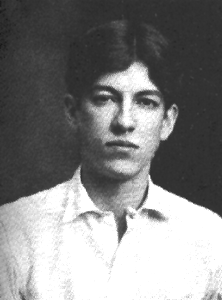
 God knows 'twere better to be deep


